REACTORS
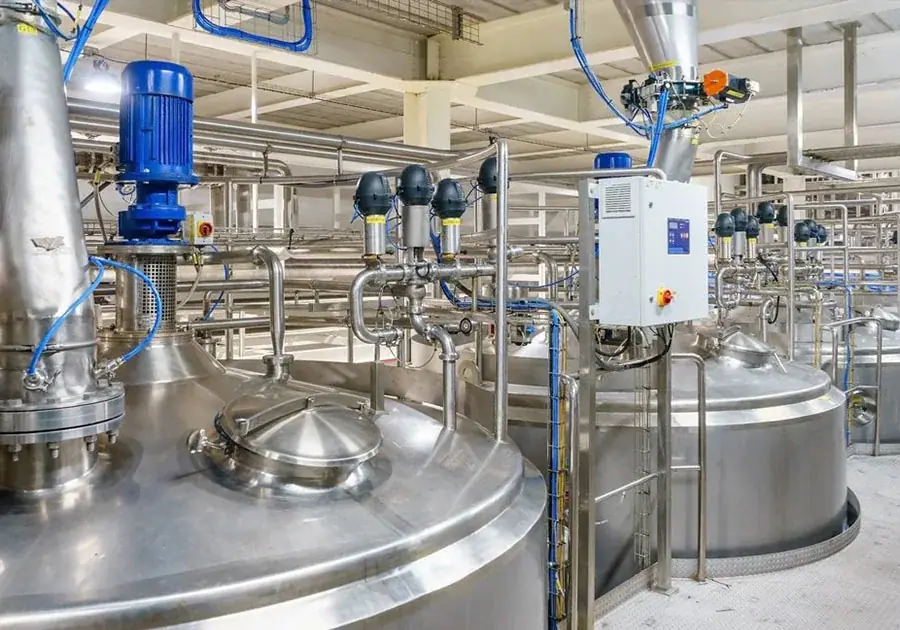
Jacketed, agitated and automated stainless process reactors
A process reactor is a closed stainless vessel in which chemical reactions take place under controlled temperature, pressure and mixing. It works as a system together with raw material inlets, agitator, heat transfer jacket, condenser connection, safety equipment and instruments.
At OPTA Mühendislik we calculate reactors from your process's heat balance, viscosity range and design pressure. We select the agitator type (anchor, turbine, disperser, ribbon) for the product and install the reactor turnkey with powder and liquid feeding, dosing, piping and PLC / SCADA automation.
We deliver reactors and process tanks for detergent, adhesive, resin, paint and chemical plants.
Agitator types
| Anchor | Turbine / propeller | Disperser | Dual agitator | |
|---|---|---|---|---|
| Viscosity | High | Low – medium | Medium – high | Wide range |
| Purpose | Heat transfer, wall scraping | Fast mixing, dissolving | Powder dispersion, breaking lumps | Disperser + anchor together |
| Speed | Low | Medium – high | Very high | Independent speeds |

Reactor system
A reactor does not work alone; it operates together with powder and liquid feeding, a heating–cooling unit, condenser, vacuum pump and automation. We design these components on a single P&ID.
- Powder feeding: big bag, bag, vacuum
- Liquid dosing: weighed or by flow meter
- Heating: hot water, steam, thermal oil
- Load-cell weighing and SCADA records
Equipment and standards
Standard
- AISI 304 / 316L body
- Agitator and geared motor
- Manhole, sight glass
- Level and temperature measurement
- Full drain valve
Optional
- Heating / cooling jacket
- Disperser or dual agitator
- Load cell weighing
- Operation under vacuum or pressure
- CIP cleaning nozzles
Standards
- PED 2014/68/EU
- ATEX 2014/34/EU
- Calculation based on EN 13445
More in Reactors and tanks
 Heated mixing tanksTemperature-controlled mixing with a jacketed body and agitator.→
 Static mixerIn-line continuous mixing with no moving parts.→All reactors and tanksLiquid Processes→
Frequently asked questions
How do you determine reactor volume?
Taking into account batch size, the product's tendency to foam and the headspace needed by the agitator, the working volume is usually chosen to be 70–80% of the total volume.
How is powder fed into the reactor?
It is fed in an enclosed way from a big bag or bag station by vacuum conveying or screw, with dust extraction.
Can you connect our existing reactor to automation?
Yes. We connect temperature, level, weighing and valves to a PLC and move it to recipe-driven automation.
Let’s work together on reactors
Tell us about your raw material, capacity and site, and we will come back with a preliminary design and quotation.