Pigging System
Recover the product in the pipeline and speed up product changes
Pigging is the process of pushing a flexible plug called a 'pig' through a pipeline with compressed air or product, driving the product left in the line into the target tank. Product in the line is recovered instead of wasted, and cleaning time and cleaning water consumption at product changes fall significantly.
At OPTA Mühendislik we design pigging systems with pig launching and receiving stations, pig-compatible pipe and valve selection, sensors and automation. They increase the efficiency of multi-product lines in detergent, cosmetics, paint, oil and chemical plants.
How does pigging work?
The animation was made from the 3D model of a pigging system in one of our projects: a 33-metre overhead line, 12 feed points, pig launching and receiving stations at both ends and a recovery tank. Click a step to jump to that moment.
- Product transferProduct is transferred along the 33-metre overhead line to the feed points. During transfer the line is full of product from end to end.
- Pig launchWhen the transfer ends, the pig in the launching station is released; it passes through the riser into the main line. A position sensor confirms the pig has left.
- Air driveControlled compressed air is applied behind the pig. The pig scrapes the pipe wall and pushes the product ahead of it, leaving a clean line behind.
- Pig receiving and recoveryThe pig stops in the receiving station at the end of the line. The product ahead of it flows into the recovery tank; the product in the line is collected rather than wasted.
- Clean lineThe line is ready for the next product. The pig is driven back to the launching station by air for the next cycle.
What is a pig and how is it chosen?
Flexible body
The pig is made from a flexible material suited to the product, such as silicone, polyurethane or EPDM; it deforms through bends and fits the wall tightly in straight runs.
Detectable core
A magnet in the body lets the sensors at the stations detect the pig's position without contact.
Bore fit
The pig is made to the pipe's inner diameter; the line must have no diameter changes, protrusions or dead zones.
Product compatibility
Material and hardness are chosen for food, cosmetic and chemical products.
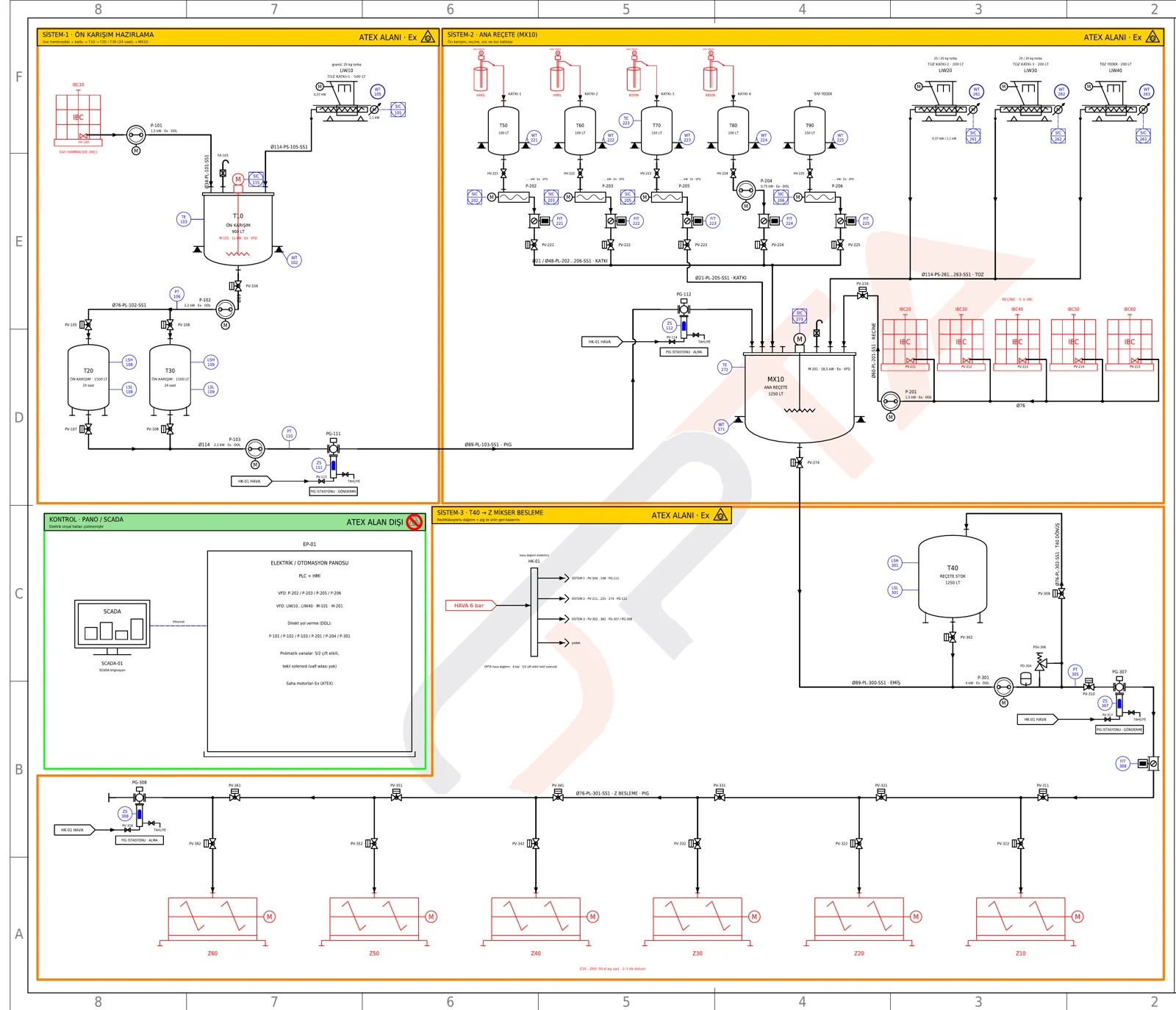
Project example: recipe plant with pig stations
In this recipe preparation plant we designed, pigging is used on three separate lines. The line from the premix tanks to the main recipe mixer, the line from the mixer to the storage tank, and the distribution line from the storage tank feeding six separate mixers are all equipped with pig launching and receiving stations.
On the distribution line, the pig pushes the product to each mixer through valves that open in turn, and stops at the receiving station at the end of the line. There is no need to wash the line at product changes, and product left in the line is recovered to the tank.
- 3 pigging lines
- Pigging in multi-point distribution
- Pig position sensors
- Central air distribution manifold
Line design for pigging
Bend radius
Long-radius bends (usually 1.5D and above) are used so the pig can pass without jamming.
Full-bore valves
Valves on the line are full-bore so the pig can pass; branches can be made with special piggable valves.
Constant inner diameter
The inner diameter is kept the same across pipes, fittings and connections; weld seams must be smooth on the inside.
Controlled air
Drive air is controlled by a pressure regulator and valves; pig speed is set according to the product and line length.
Safety
There is air venting at the end of the line, pressure monitoring and safety interlocks on the station covers.
Automation
Pig position, valves and air sequence are managed by the PLC; the operator starts the cycle with a single button.
Benefits
Less product loss
Product in the line is not wasted; it becomes saleable product.
Less waste water
Cleaning water and chemical consumption fall.
Fast product changeover
Different products are transferred through the same line in a short time.
Fewer lines
No need for a separate line for each product.
Equipment
Standard
- Pig launching and receiving stations
- Pig-compatible pipes and bends
- Pig detection sensors
- Air drive circuit
- PLC control
Optional
- Multi-destination pigging
- Manifold and piggable valves
- CIP integration
Standards
- PED (on pressurised lines)
- Food-grade materials (option)
More in Transfer and dosing
 Liquid dosingRecipe-based liquid dosing by weight and flow meter.→
 Viscous fluid transferPumps and heated lines for resins, putties and oils.→All transfer and dosingLiquid Processes→
Frequently asked questions
Can pigging be added to our existing pipeline?
It can be added if the routing, bend radii and valves allow the pig to pass; if not, we renew the relevant sections.
How long does a pig last?
It depends on the product and frequency of use; it is replaced periodically based on wear monitoring.
Which products is it suitable for?
It gives the greatest benefit with viscous and valuable products and on lines with frequent product changes.
Let’s work together on pigging (pipeline cleaning) system
Tell us about your raw material, capacity and site, and we will come back with a preliminary design and quotation.